POÇOS DE CALDAS, Brazil—Western companies are pouring money into Brazil’s rare-earth industry, hoping the South American nation can help loosen China’s grip on the minerals used in electric vehicles, wind turbines and advanced weapons.
Miners are racing to develop deposits across Brazil, which holds the world’s second-largest rare-earth reserves after China. But their ambitions extend beyond digging up ore. Companies and government officials say they want to build processing plants that can separate rare earths, produce metals and eventually manufacture magnets.
The realization of that ambition would represent a much bigger challenge to China. While Beijing holds roughly half of global rare-earth reserves, it controls more than 90% of processing and magnet production, giving it a dominating influence over global supply chains.
“This is world-class geology,” said Rafael Moreno, chief executive of Australian-listed miner Viridis, one of several companies developing projects in southeastern Brazil. “Brazil is now positioned to play an increasingly strategic part in supplying critical raw minerals to Western economies.”
The push has turned Brazil into a focal point in the struggle between Washington and Beijing over critical minerals. The U.S. has been scouring the globe for rare earths, backing projects from Africa to Australia in an effort to loosen Beijing’s grip on the industry.
Yet Brazil has resisted pressure to join a U.S.-led minerals bloc, insisting it will accept investment from any country willing to help develop the industry.
“Brazil is open to investments from whichever country respects our sovereignty,” Mines and Energy Minister Alexandre Silveira said in an interview. “We’ve been in talks with various foreign players including the U.S., the European Union, China and others.”
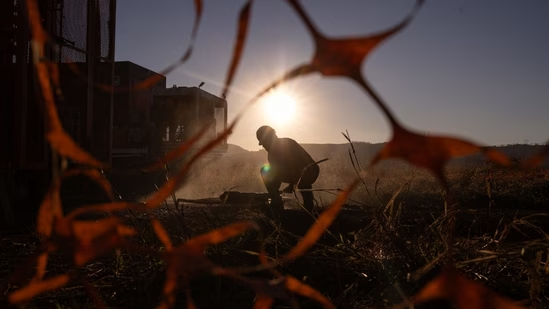
Poços de Caldas, a city built in the caldera of an extinct volcano, has become one of the centers of the rush. A towering Christ the Redeemer statue overlooks a landscape rich in the clay deposits that miners think could help reshape global supply chains.
After opening a pilot plant in the city last month, Viridis plans to begin production in 2028, including scarcer heavy rare earths that help magnets retain their strength at high temperatures—crucial for everything from electric vehicles to jet fighters.
Like many of Brazil’s rare-earth deposits, Viridis’s reserves are found in clay, which executives say is cheaper and easier to process than the hard-rock deposits common in Australia and elsewhere. Cheap hydropower, relatively low labor costs and proximity to U.S. markets have further deepened investor interest.
For years, rare earths attracted little attention outside mining circles. That changed in 2025, when China imposed export controls on several rare-earth elements and magnets in response to trade tensions with Washington, exposing the extent of Western dependence on Chinese supply chains.
Western governments and manufacturers have rushed to develop alternatives.
Under President Trump, the U.S. has backed the industry with financing, purchase agreements and guaranteed prices designed to prevent China from driving competitors out of business by flooding the market.
Much of that investment is heading to Brazil. The country holds an estimated 21 million tons of rare earths, roughly a quarter of global reserves, according to the U.S. Geological Survey. More than 3,000 applications for research permits related to rare earths have been filed since the beginning of 2023, compared with 476 between 1975 and 2020, according to Brazil’s National Mining Agency.
Australian miners Viridis and Meteoric are advancing neighboring deposits in Poços de Caldas, while Canada’s Aclara is developing a project in Goiás state. In April, USA Rare Earth, backed by U.S. government financing, agreed to pay $2.8 billion to acquire Serra Verde, the only large-scale producer outside Asia extracting rare earths from clay deposits.
The bigger question is what happens next.
Today, most rare-earth supply chains remain dependent on China for the lucrative processing stages that separate individual elements and convert them into the metals, alloys and magnets that are used in everyday electronics. Brazil wants a greater share of that business.
President Luiz Inácio Lula da Silva has said he doesn’t want Brazil to become merely another exporter of raw materials. Instead, he wants foreign investors to help build a domestic rare-earth industry capable of generating higher-value jobs and technology.
Investors expected discussions about critical minerals to feature prominently during Lula’s meeting last month with Trump at the White House. No agreement emerged. Lula later said Brazil wouldn’t favor one nationality over another. “We have no preference,” he said.
Like other miners, Viridis initially plans to export the rare earths produced at its $360 million Colossus project. In its case, the material would be sent to a separation plant operated by the Franco-Belgian chemicals company Solvay.
By the 2030s, however, the company hopes to separate some of its rare earths in Brazil and recycle magnet waste generated during manufacturing.
Building a complete supply chain takes time, Moreno said.
How quickly that develops depends in part on Brazilian policy. Industry executives warn that overly strict local-content requirements could discourage investment, while overly lax rules could leave Brazil exporting raw materials and missing out on higher-value processing.
Brazil’s Congress is still completing legislation governing strategic minerals. Lula’s reluctance to back plans for a state-backed rare-earth company reassured some investors.
The biggest challenge for Washington may be Brazil’s determination to remain neutral.
Mining companies have positioned themselves as important contributors to efforts to build a rare-earth supply chain outside China. Serra Verde, which historically shipped its material to China for processing, recently signed a 15-year supply agreement backed by U.S. government agencies and private investors. Viridis and other miners have also held discussions with the U.S. International Development Finance Corp.
Yet Brazil has shown little interest in restricting Chinese access to its mineral wealth.
Beijing continues to invest heavily in Brazilian mining assets. Chinese electric-vehicle maker BYD and other manufacturers are also bringing the type of industrial investment Brasília has long sought.
That raises a possibility that concerns some Western executives and policymakers: that Brazil could emerge as a rare-earth power without necessarily becoming part of a Western supply chain.
“There’s a huge opportunity here for Brazil,” said Reg Spencer, an analyst at Canaccord. “But the complicating factor is their decision not to pick sides.”
Write to Samantha Pearson at samantha.pearson@wsj.com