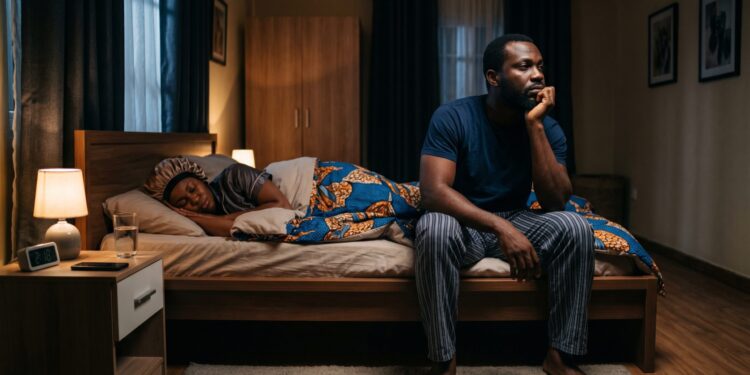
For these Nigerian men, learning they might never have children went beyond the diagnosis. These six Nigerian men share how infertility changed their relationships and self-worth.
Charles*, 43
I was diagnosed with a varicocele as a teenager after years of pain and swelling. Even then, I didn’t totally accept that it could mean infertility. I told my wife before we got married, and we agreed we’d face whatever came. But it wasn’t until we started trying for children and nothing happened that the reality truly sank in.
We’ve been married for almost seven years now. Watching our friends have children has been one of the hardest parts. Every naming ceremony invitation feels like a reminder of what we’re missing. Even sex has become difficult. It no longer feels separate from the issue. My wife has never made me feel less than a man, but I still find myself apologising.
When she eventually told her parents, I became convinced they saw me differently. She says it’s all in my head, but I can’t help noticing how much warmer they seem with their other sons-in-law.
We’re still exploring treatment options, and I’m saving for advanced care abroad. If that doesn’t work, we’ll probably adopt. Until then, I’m holding on to faith. What makes it bearable is having a partner who never makes me feel less than myself.
Ahmad*, 37
My wife and I lived in different states after we got married in 2018, so having children wasn’t an immediate priority. But once we settled down and started trying during lockdown, we realised something wasn’t right.
Tests eventually revealed I had a very low sperm count. I’ll never forget that appointment. The moment the doctor told me, everything else became background noise. I left feeling completely defeated.
There was still hope through IVF, and after a year and a half of trying, we finally had a successful cycle. Five weeks later, my wife miscarried. Around the same time, we also discovered she had fibroids.
Since then, it’s felt like carrying a hole in my chest. You can have a good career and money, but none of it fills the emptiness of coming home to a house without children.
We haven’t given up, but we’re slowly learning to accept that things may not happen the way we imagined. The hardest part has been talking about it. My wife can discuss it openly with her siblings, but I’ve told no one. Even now, I struggle to say it out loud.
John*, 56
For years, my wife was the one undergoing tests because it was hardly assumed the man would have an issue. After four years of trying, I finally agreed to get tested. That’s when I learnt I was sterile.
I didn’t believe it at first. I spent years convincing myself that if we prayed harder or waited longer, things would change.
The reality didn’t set in until 12 years into our marriage. One morning, my wife asked what the point of working so hard was if we had nobody to inherit the rewards. I went to work as usual, but when I sat at my desk, I broke down crying.
That was the day I suggested we adopt. We eventually took in a young relative and raised him as our own. But now that he’s a teenager, he acts out and sometimes says he wants to go back to his parents.
Even now, people still ask when we’re having children and quote the story of Sarah and Abraham. My wife always smiles and says we’re praying, but what hurts most is knowing that people automatically blame her.
Chibuzor*, 39
I did drugs and smoked heavily from my teenage years until my late 20s. I’d left that life behind, so when my wife and I started trying for children soon after marriage, infertility never crossed my mind.
Two years in, we got tested. That’s when a urologist told me I had immotile sperm. After asking about my lifestyle in my twenties, it became clear that my past had likely contributed to my condition. My choices had finally caught up with me.
For years, I blamed myself. I grieved the children I’d never have and carried a guilt that seeped into every part of my life. My wife eventually pushed me to try therapy, and it helped more than I expected. I was able to forgive myself and focus on the way forward.
In 2022, we adopted a baby girl. I love her completely, but the grief hasn’t disappeared. A part of me still aches for the biological child we’ll never have.
Prince*, 37
My wife and I were celibate until marriage, so when we struggled to conceive, she suggested we get tested. That’s when I learnt I had low testosterone and erectile dysfunction.
The diagnosis was difficult, but what hurt most was what it did to my marriage. My wife felt betrayed and believed I’d knowingly put her in that situation.
I was willing to do anything to keep us together. If she wanted adoption, a sperm donor, or even to have a child with someone else, I would’ve accepted it. But she couldn’t move past it, and after four years together, she left me.
I’ve never fully recovered from the divorce. Losing my marriage shattered my confidence. Even now, I find myself wondering whether anyone would willingly choose a man who can’t give them children.
Mubarak*, 28
I got gonorrhoea from a sexual partner and didn’t realise it until I started experiencing serious symptoms. By the time I saw a urologist, he said they could treat it, but I’d developed epididymitis, and there was a high chance I might never be able to father children.
I remember sitting in the doctor’s office wondering how I was supposed to continue my life with that information.
I know there’s a small possibility I could have children, but I’m preparing myself for the worst. Surprisingly, the hardest part hasn’t been the diagnosis itself, but telling other people.
When I confided in a few friends, they mocked me. One of them often jokes that I don’t need condoms anymore since I can only shoot blanks. I regret opening up to them.
I’m dating someone now, and I haven’t told her. Part of me feels guilty, but I’m terrified of how she’ll react. If my friends could reduce my situation to a joke, what would someone I plan to build a future with think?
Read Next: We Were Planning Our Wedding. Then He Got Cancer